
There’s a moment in every session where the drums either unlock the track or quietly suffocate it. For producers working in nu disco, melodic house, or anything else where the groove is the whole conversation, that moment arrives early — and getting it wrong can cost you hours. The Boomcha Sampleson review from Magnetic Magazine’s Will Vance raises a genuinely interesting question for our corner of the underground: does a plugin built on 1.5 million real-drummer rhythm cells actually help music that lives and dies by feel?
The short answer is: more than you might expect, with some honest caveats worth understanding before you spend your money.
What Boomcha Offers Working Producers
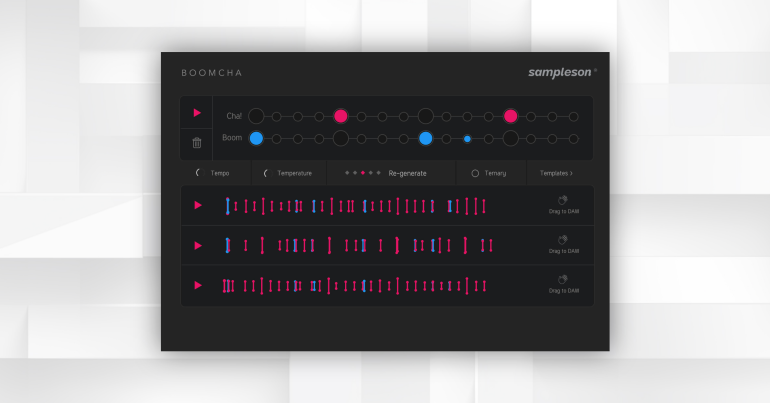
Boomcha’s premise is refreshingly human in its logic. You sketch a basic pulse — kick, snare, clap placement — and the plugin searches its enormous library of captured drummer performances to return a fuller groove, complete with the micro-timing shifts and velocity variations that separate a played part from a rigid piano-roll grid. The result lands in your DAW as fully editable MIDI, which means you keep creative control. This is a groove quantization tool in spirit, but one that leans toward humanisation rather than mechanical correction.
For producers who have lost entire afternoons auditioning sample packs that don’t share the same rhythmic feel, this approach is genuinely liberating. You’re starting from intent — your intended kick-snare relationship — rather than trying to force borrowed loops into a track they weren’t written for. The drag-and-drop MIDI workflow keeps things moving; Boomcha gets out of the way once it’s done its job, which is a virtue too many production tools ignore.
The interface supports that speed. A grid-based input makes the concept clear immediately, genre-oriented templates frame the output practically, and the plugin runs as both a standalone application and a DAW insert. No manual-reading required to get somewhere musical.
Where It Gets Nuanced for Groove-Led Music
Here’s where the honest caveats come in, and they matter for our audience. Vance found Boomcha most complete when working in pop, hip-hop, rock, or Latin production — styles built around a strong central pattern. In progressive house and organic house, where the groove is often assembled from layers of carefully placed percussion, ghost notes, and movement that builds across long sections, Boomcha delivers a solid foundation but doesn’t finish the upper tier of detail for you.
For nu disco and melodic house production specifically, that means treating Boomcha as a drummer MIDI plugin that gets you to a convincing core loop quickly — and then trusting your own ears to build the texture outward. That’s not a flaw; that’s a clear scope. A lot of sessions stall precisely because the foundational groove was never properly established, and Boomcha solves that specific problem with unusual speed.
- Grooves carry genuine velocity movement and timing variation — not random, but drummer-informed
- Output MIDI is fully editable; swap sounds, rework accents, layer freely
- Genre templates help frame starting points without locking you in
- No Pro Tools support, which will matter for some studios
- Dense, detail-heavy percussion arrangements still need your hands at the end
Vance also makes a point worth passing on to newer producers: Boomcha has real teaching value. Hearing the difference between what a rigid grid produces and what comes back from a drummer-shaped performance is, in itself, an education in groove. For anyone still learning why some loops feel alive and others feel stuck, that comparison is instructive.
For groove-obsessed producers who want a faster path to a foundation they can genuinely build on, Boomcha by Sampleson earns a considered look. Just know what you’re asking it to do — and where your own programming still has to show up.