
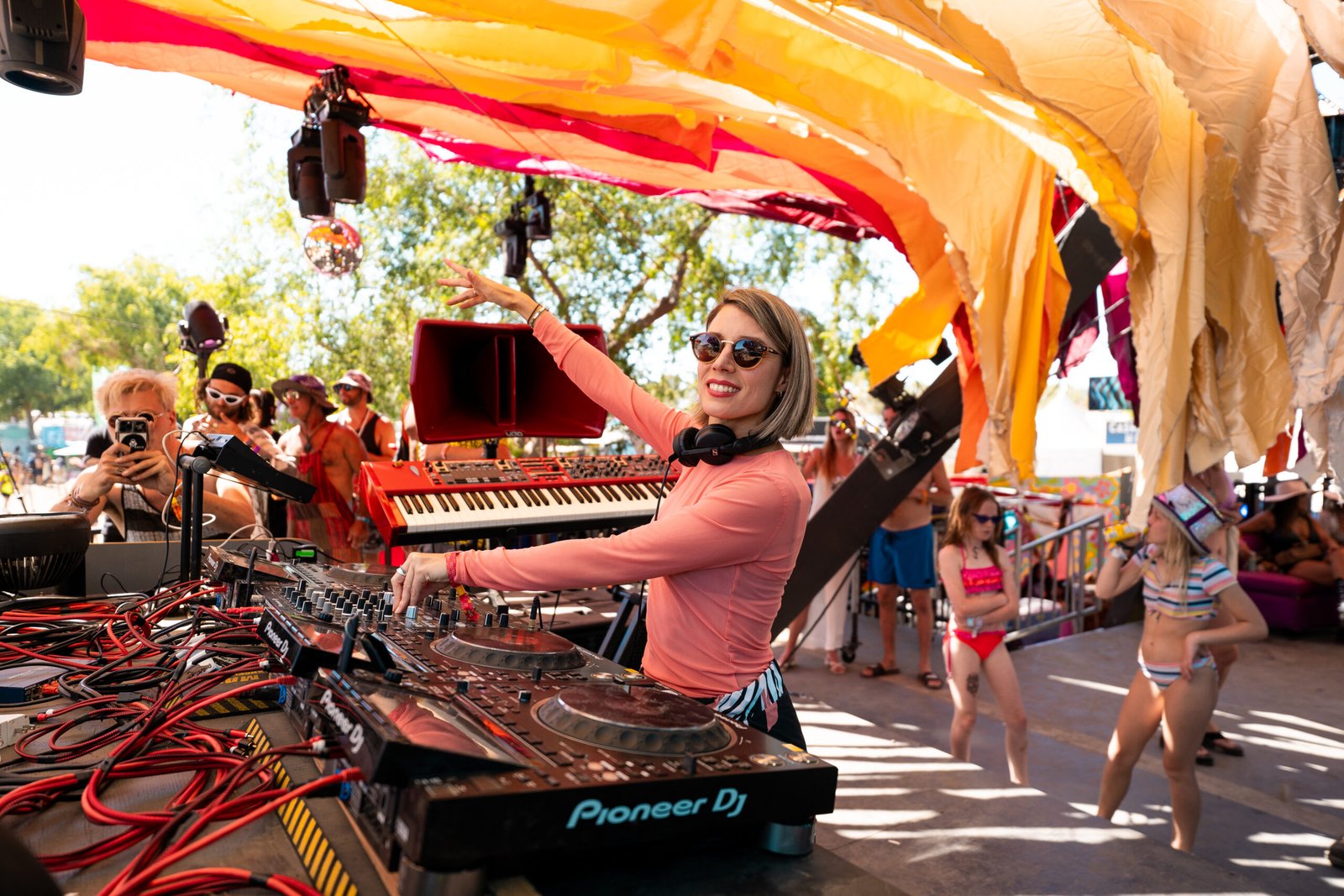
French-Brazilian producer, pianist and live electronic artist Ella Romand has built her sound across three worlds: the musical foundations of her classical piano training, the Brazilian and Latin influences of her upbringing, and the electronic scenes she encountered across Brazil, San Diego and Miami. Now based in Miami, Ella brings keys, synthesisers and live instrumentation into her productions and performances, creating a sound that moves between Deep, Organic, Afro and Melodic House. Her latest release, a remix of Husa & Zeyada’s ‘More Love’, brings these influences together in a more club-focused interpretation, pairing a groove-led production with live keys, organic textures and the hypnotic character of the original.
Beginning on piano by ear at the age of five in southern Brazil, before moving into classical training, gave you a strong foundation. How has that early grounding shaped the way you approach electronic music today?
Having a solid music found has been very helpful over the years, not only in the studio but it has helped me shape how I perform too. By being adding to live instruments is has allowed me to be more creative as well. In electronic music, creating a groove is essential, but being able to also transmit emotions through instruments makes it a lot more personal and it has helped me transmit who I am.
Sasha’s ‘Involver’ was an early discovery, and Curitiba’s club scene followed when you were 16. Can you recall the moment you realised electronic music was something you wanted to pursue seriously?
Yes, I recall that moment quite clearly actually. I always loved music, and despite studying piano for a number of years, I stopped when I first moved to the capital (Curitiba) for the last year of high school. At the time in the south of Brazil a degree in Fine Art was the closest to a music degree I could find, and I ended up enrolling in Architecture school/College. After 1 year or so, I paused it to live an experience abroad (San Diego, CA) only to find myself taking a course on Music Production back in Curitiba a few months later. The very first day in class, I felt absolutely IN LOVE with the process of music production and the fact that I could be a “maestro” orchestrating all the different instruments in real time on a computer. It was my “aha” moment. A year later, I moved to San Diego (CA) to pursue a degree in Music, and 2 years later I moved to Miami to finish my degree in Music Technology.
Studying production in Brazil, then San Diego, then Music Technology at Florida International University in Miami makes for quite a journey. How did each of those places influence both your sound and your outlook as an artist?
Each place (and institution) had a different influence on me and the way I perceived and understood music. Brazil has always been influenced by American pop music, but when it came to electronic music, it was the European sound that prevailed back then, specially UK (Sasha, Nick Warren, Danny Howells, Pete Tonge and so on). When I first learned music production at AIMEC in Curitiba (BR), that sound was mostly predominant. On the other hand, the music program at San Diego Mesa College was more around classical music as well as jazz. It was also when I first heard of WMC, and it was one of the reasons why I moved to Miami a couple years later.
That fact that Miami is also a very international city carrying not only a Latin music and electronic in it’s veins and down the streets, influence in Miami has always been very international, but Latin is undoubtedly the main, along with electronic music on every corner from the first moment I stepped into this city. .
Miami’s electronic scene played a big part in your early breakthrough, from winning the Electric Pickle mix competition to the residency at Do Not Sit On The Furniture. What did that period teach you about developing an identity as a DJ and producer?
When one is starting their career, we don’t really think about our music identity or how we sound until your friends, or people who have been watching you, might describe your sound in a certain way. DJ Behrouz was one of the first ones to say my sound was deep and sultry, and that my sets could tell a story. Back then as a resident at Do Not Sit playing week after week, I started to realize I did have a certain sound, and that it “sculpts” over time as your style and music taste evolves. I was lucky to also open to many major acts that were playing at DNS intimate club, such as Eli & Fur, Rodriguez Jr, Eelky Klein and so many others that I had the chance to warm up the room for. Warming up a room – and closing – are two of the best teachers for a DJ.
Keys and synthesisers have become central to your live performances, an approach you first explored with Dsided in 2015. What does playing live add that a traditional DJ set doesn’t, and how do you keep the balance on the dancefloor?
The great thing about playing live is that you never know how a set might come out. There is an additional layer of spontaneity that comes when adding live instruments. And in addition to making a performance more unique, that live layer makes the set more personal and unique. Two sets are never the same. I keep it dancefloor forward by always adding fresh new tracks that are groovy, yet always allowing me some moments to still jump on top of the jeys to jam along.
Co-producing, composing and performing alongside more than 80 musicians in the New World Symphony collaboration was a landmark project. How did it compare with your usual work, and did it change the way you think about bringing classical and electronic music together?
Producing electronic music that is meant to be arranged and performed by an orchestra along with electronic music, is another beast. I did not know at first that my productions were going to be arranged for the orchestra since the original request was to make “beats”, but I inevitably added melodies and harmonies using synths, keys, pads etc, along with a groovy beat. The arranger (Sam Hyken) decided to keep it and arranged it for the whole orchestra, and to see the 2 music worlds I grew up with collide, it reminded me how powerful music is, doesn’t matter where you are from. I would love to create that experience again and might have something to share sometime soon 😉
Ellaments began as a radio show during the pandemic livestream period and has grown into a platform for live music, visual artists and immersive events. What inspired the move beyond radio, and what should people expect from an Ellaments event?
I have been lucky to create a community, first around Miami and then beyond with the radio show. So turning Ellaments into an event experience felt like a natural evolution. We have produced events for Miami Music Week, boat party, and even a villa party in Ibiza. And what all these events have in common is a community that is in love with the music, charged with good vibes, in an intentional atmosphere that connects like-minded people through live experiences. From culinary experiences to art, live painters, and live musicians, all Ellaments events brings in a unique setting that makes each event feel special.
Husa & Zeyada’s ‘More Love’ started out as a slow-tempo indie electronic track before your remix gave it a more club-focused energy. What made it the right track to rework, and how did you decide how far to push it?
Adam (Husa) and I had been in touch for some time looking for the right opportunity to collaborate. When he shared “More Love”,I was instantly hooked by the vocals and trippy guitar, which were the perfect ingredients to turn into an electronic track.
Since this was right around summer, I imagined playing it at a fun day time party in Ibiza (which I did!) and having fun while playing it. So it wasn’t so much about pushing the track, but creating a remix that would be great to play all summer long.
Can you talk us through how the remix came together in the studio, and where live instrumentation fits into your production process?
The creative process was very natural. I first tried to work with the minimum amount of elements until I found the right groove, which came along with a bouncy bassline. Then I added keys and synth, and chopped the vocals to add more groove, while using parts of the original guitar to create patterns. Jamming with the keys live along with the track while producing it allows me to put out different ideas, so I can later filter and see what sticks and what doesn’t. I also like to record live shakers and edit their grooves to fit the track.
With the ‘More Love’ remix now released, what’s coming up for the rest of the year, including new music, live shows and Ellaments plans?
Music wise, I have a few tracks I’m wrapping up in the studio, along with some collaboration. I’m also constantly announcing new gigs as they get confirmed both on my IG and website (www.ellaromand.com) As for Ellaments, we have something special on the works that I can’t share it just yet but keep your eyes peeled on our socials 🙂
Find Out More & Follow:
Ella Romand: Spotify | Beatport | Traxsource | Instagram