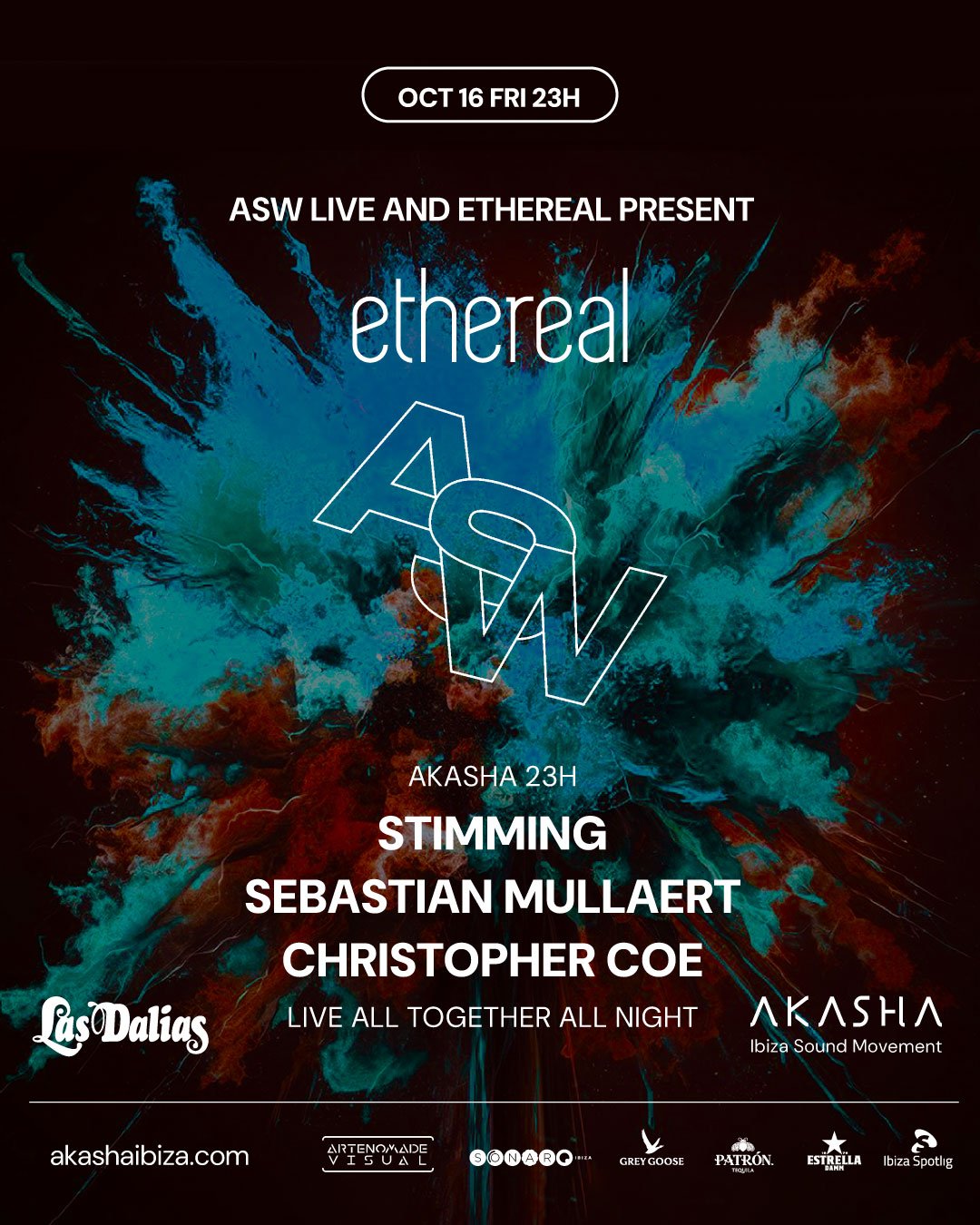
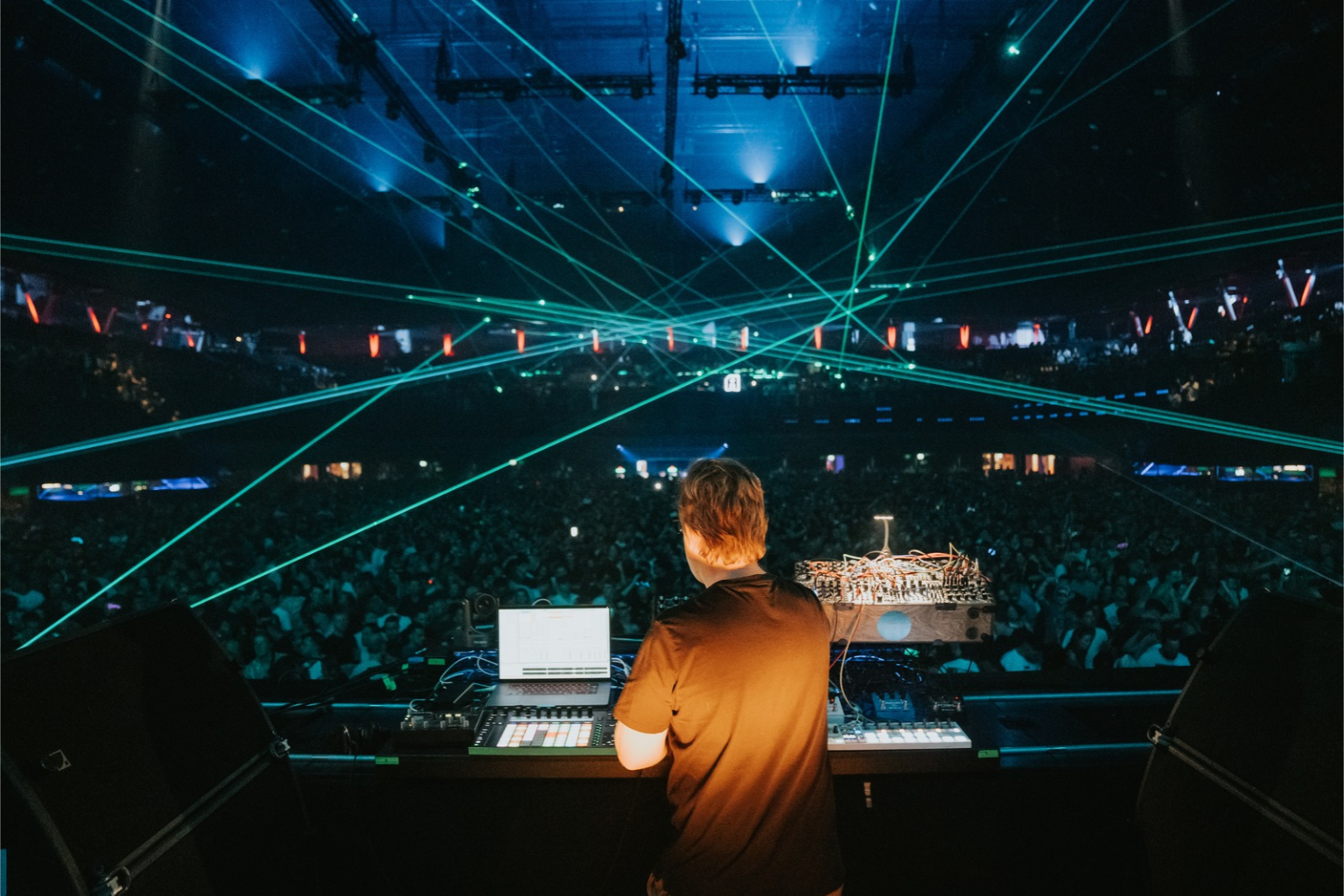
Stimming, Sebastian Mullaert and Christopher Coe approach live electronic music from three distinct perspectives, shaped by hardware, improvisation and a shared belief in creating music in the moment. On Friday 16th October, Awesome Soundwave and Ethereal Ibiza bring the three together at Akasha Ibiza for an all-night live performance, improvising in real time through modular synths and hardware.
The show forms part of the growing Awesome Soundwave Live series, which has already visited Dublin and Belfast this year. Ahead of the event, we spoke with all three artists about what makes a performance feel genuinely live, how they balance preparation with spontaneity, the role of hardware, and the ways the room and the audience shape what they play.
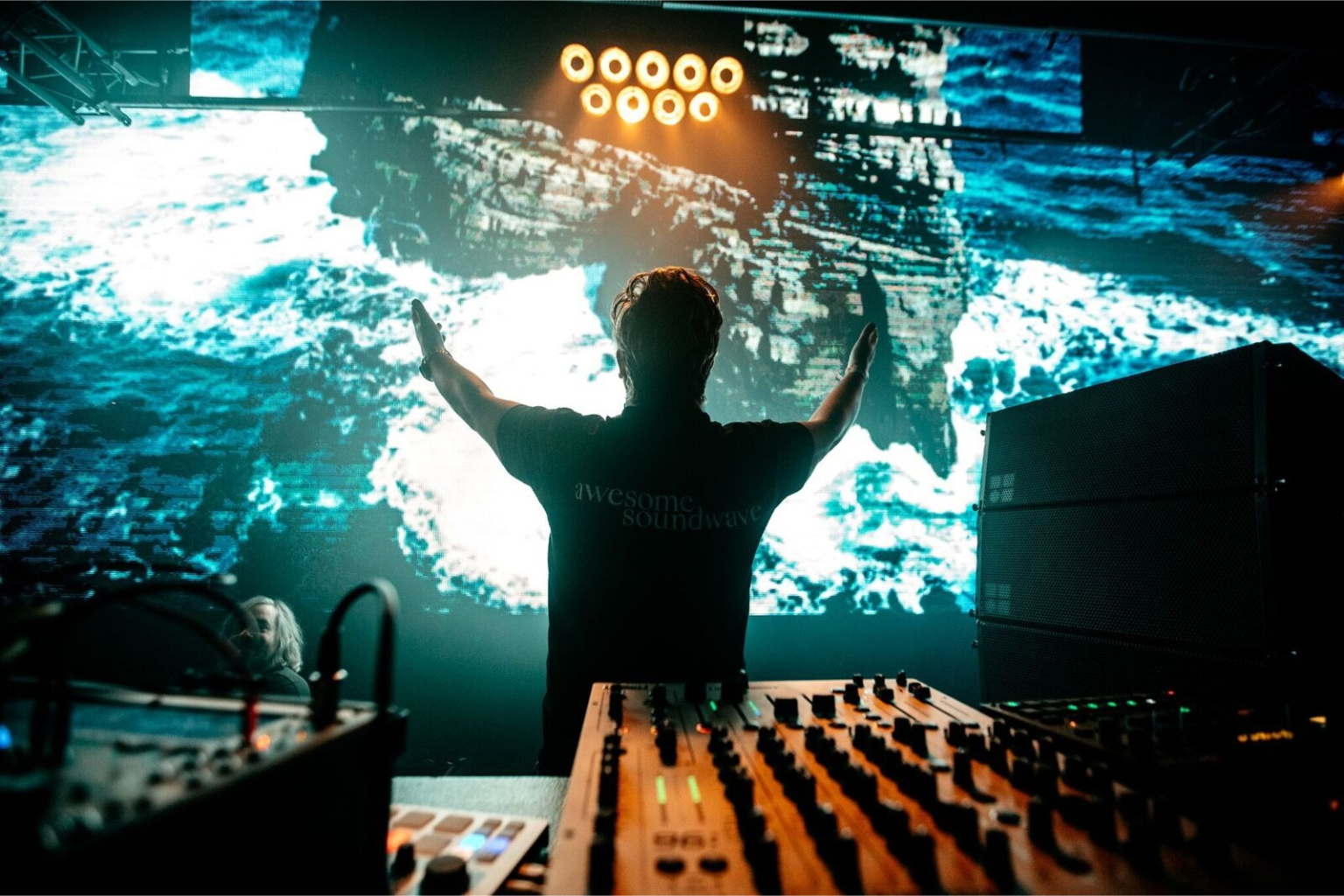
Stimming:
Your music is known for its detailed textures, field recordings and organic approach to electronic production. How does that translate when you take the music into a live environment?
It’s difficult to translate, as the stage asks for different, faster, more direct actions, instead of my carefully crafted studio work. To strike a balance here, between complex live-action and “simple” wav-file playing, is my challenge
What makes a live electronic performance feel genuinely different from listening to a finished studio recording?
A live set is a lot more rough, while it has the magic of something happening right now – something that will never be replaced by machines.
How much of your live performance is prepared in advance, and where do you deliberately leave room for improvisation?
I would say, 60-70% is prepared, but this means the finished tracks I play in a semi-spontaneous way. I have around 35 tracks that are ready to play, but which tracks, how and which order is absolutely not planned. The tracks are cut in parts, so I can freely decide to stay in a part (while the original would have gone further) or skip something if I don’t feel it.
You have a very recognisable approach to sound and production. How do you avoid becoming too attached to a particular way of working?
I am driven a lot by technology, mostly hardware devices for playing live (and crafting and harvesting ideas for finished tracks), so this gives me a natural approach to progression. It’s honestly more that I feel the hardware is developing faster than me, so especially the latest generation of hardware, like 1010music’s bento, torso’s S4 or the upcoming dada machines tbd-16 are really a big step forward in capabilities while still being playable. Learning these machines and its possibilities is a big part of my creativity – a part that can be a burden, or even contra-productive like the op-xy, but they take care that I stay vivid.
What role does hardware and physical interaction with your equipment play in the way you perform?
I have this idea of a jazz combo in mind, but for dance music. Of course, as just one person it’s barely possible, so I need to lay a groundwork on that I can play on, but in general I wish I could create new music on the fly. This isn’t possible yet for our modern ears.
How does the room influence what you play? Do you approach an intimate club differently from a large festival environment?
Of course I do, but the rules for a liveset are different to the ones for a DJ. I dont have that much time, and I also technically have a lot more to do than someone who plays and mixes records. I usually decide for the first four to six tracks in advance, depending on where I am and then improvise from there. Big rooms – big gestures, small room – small gestures.
You have been performing live for many years. What has changed most in your relationship with the audience?
Not that much to be honest 😉 but it took me years to understand that for a liveset, it’s mostly like that: if I like what I’m doing, people like it as well.
Is there a particular part of your live setup or performance process that you think audiences might not realise is happening in the moment?
I have a story about that particular thing. Once I was playing one a huge Diynamic Festival in Amsterdam and always had a moog voyager on stage at that time, which the promoter had to rent from me (I don’t do that anymore as too often the rented gear turned out to be faulty). After my set, the stage manager asked me, if I at all used the moog, which I took totally as a compliment: I was using it pretty much all the time, but so well crafted into the general sound that she didn’t realize. I like when a sound I create on the spot kind of cuts through so people recognize it, but the technician inside of me also likes it when it’s elegantly blended. Just like in a good recipe – you shouldn’t taste a particular ingredient.
After so many years of producing and performing, what still gives you a reason to experiment with your sound?
As I said, the technological advancements are huge and so is my interest in using them. Those advancements just get bigger as AI helps developers bringing their ideas into reality which I believe is the start of a golden age of software development, right now. I’m looking forward to these new possibilities, given they are made for enabling human creativity, something a machine will never accomplish.
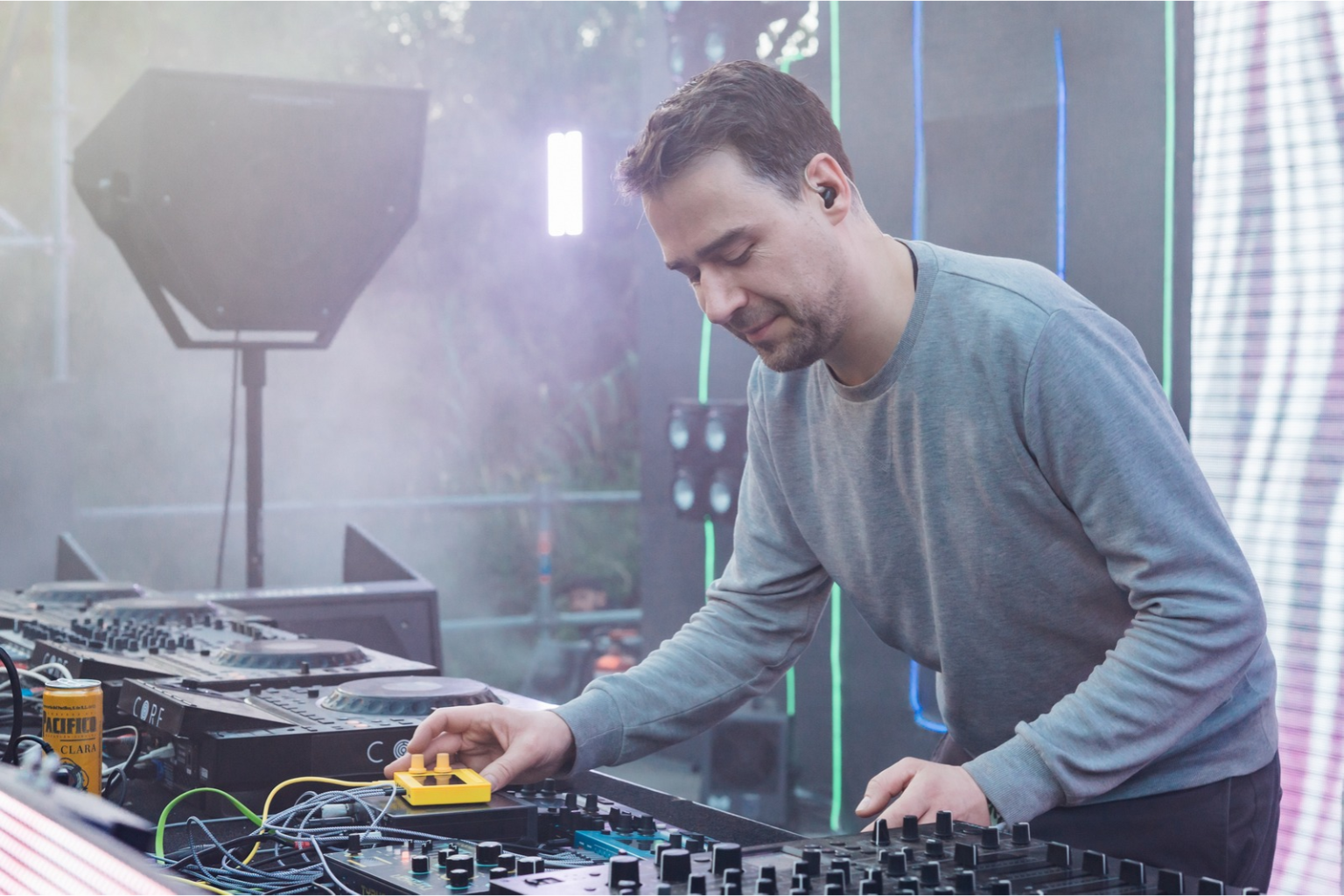
Christopher Coe:
You’ve spent years developing a very distinct approach to live electronic performance. What makes a live set feel genuinely ‘live’ to you?
Well, the age old question and one that I’m not sure I can answer on a technical level meaningfully. I guess really there are two elements that are most important for me to consider what constitutes a live electronic set.
Firstly, it must be one’s own original music that is being used or created either as samples, loops, or even whole tracks that you may be reworking on the fly.
Secondly, there must be real time, live improvisation at play, with whatever devices you choose, whether it be modular systems or groove boxes or whatever. A live electronic set, in my opinion, really needs to be created on the spot.
It doesn’t matter what tools one uses, you can use a DAW on your laptop, you can do it entirely on your modular rig, these are all valid tools that form part of the live rig or, as I like to see it, the instrument. Each device in the live rig forms part of the whole instrument, and when one sees it this way, in my opinion, then it frees one up to create something that is greater than the sum of its parts.
There is a lot of preparation behind a strong live performance. How do you decide what needs to be carefully planned and what should remain open to what happens in the moment?
Well, currently I do use a DAW in my set up and I have many loops, samples and whole tracks in there set up with loop points and assigned to their own channels. For example, I have many kicks that I created with rumble and basslines already processed as loops. These have their own channel on the mixer, other loops and tracks are assigned to a couple of other channels, so I can essentially mix between them as a DJ does, seamlessly, this gives me a basis upon which I can then wrangle my modular system into creating some crazy shit alongside this.
So, my preparation becomes more about considering how to start the set based on the context of the show and I go from there, improvising as things progress. I always think I must prepare better, I must plan more.. And I never do!
I like to fly by the seat of my pants to be honest, stuff comes out that I can never plan for. Sometimes I will create a sequence or find a patch that really works and I keep it and try to reproduce it, and it always leads to a whole new idea, sometimes it feels wrong and I wrestle to find something new in that moment. Sometimes I literally just drop back to the kick and bass, take a drink of water, look at the room, feel the vibe, take a deep breath and dive in again.
How has your approach to live performance changed over the years? Are there things you do now that you would never have considered when you first started?
Absolutely, when I first started I had this idea that I needed to reproduce tracks that I had released or already made, by splitting them into their component parts (Bassline, Harmonics, Drums, vocals etc) and basically rebuilding them live.. It was daunting and actually really boring for me and the crowd, I’m not a pop star or a band that needs to “play the hits”!
I realised that with live electronic music the secret is to push boundaries, improvise, make up new stuff and find new ways to keep a dance floor going or an audience engaged by building up a bunch of bits, tools, samples, sequences, tone generators and improvising every time. Now, I am much more comfortable with whatever comes my way and whatever context or type of show it is I feel i have way more flexibility and can explore new territory every time.
You’ve worked across different forms of electronic music and performance. How do you approach building a live set when the music itself doesn’t necessarily fit neatly into one genre?
I am not good with sticking to a genre specific approach, I mean Techno, in its essence, was not really a specific genre, rather it’s a feeling, a pulse and an exploration. Of course there is one golden rule when playing to a dance floor, keep the groove going! Beyond that, I don’t think of genre, I do what feels right in the moment on that dance floor, and hope to goodness I’m picking up on the right vibe with everyone ! To be honest, I think it is a 2-way thing, there is definitely an interplay between dancers, audience and the artist playing, and when we all connect, then magic happens and no one stops to analyse what specific sub-genre this may be. Because we are dancing!
How much does the space you’re performing in influence the way you play? Does your approach change significantly between a club, a festival and a more intimate setting?
Very significantly I would say, I have played at all types of events and venues, from stadiums to lounge rooms and each time it’s different.
When playing to 15,000 people, I rely a lot more on the bigger kicks, the more dramatic moves, the bigger build ups and releases, when I play a club I can go deeper and darker and when I do my Modular Lounge in a cosy room of 20 friends lying about and dancing and being free I can really experiment with more nuanced sounds, spacious ambience, deeper rhythms that take a long time to build. (that’s my favourite thing to do actually!)
Having said that, of course, I still have my own approach and style and I still improvise enormously no matter where I am playing.
What do you think audiences respond to most in a live electronic performance? Is there a particular moment when you know that a set has connected with the room?
This is a good question, and it can also be different according to context and setting. In the bigger shows, it’s a hook, a dramatic and dynamic change and build up, with a big kick and sub action that I like to work with most. I love really using that big soundsystem and pushing it to the limit! It’s fun! And sometimes it’s a total surprise to me when a moment really connects! People always love the drop to a minimal kick and bass pattern, I like to rinse that and then keep building upon it to another level whilst always staying deep! My friend Marc Romboy once called my style “Mainfloor deep”! I think I know what he meant.. But you’d have to ask him!
In the club I think it is about building a groove and sitting on it, adding layers, building upon it over time, not relenting, hold hold hold…. And hold….. ! And then bring in a surprise element, a vocal, a synth topline.. Hold more.. Build intensity… hold … hold.. Hold! And then drop to nothing! One sound, a string holding a single note, an oscillator tone… and bring it back, the kick, a bass rhythm.. And we start again.. I like that.
Maybe that’s what I always do to be honest.
What are you listening for when you watch another artist perform live? What makes you think, “I haven’t seen this before”?
Well, I want to be able to feel like I haven’t HEARD this before.. I don’t care how they do it (though the nerd in me is of course fascinated!). I want to hear sounds and combinations that are compelling, grooves that move me, space and ambience that evoke new feelings and experiences. I never know what it is until I hear it.
Awesome Soundwave is built around artists who approach electronic music as a live form. What do you think is most important about keeping that approach at the centre of the label?
I think it is multi-faceted, I think it provides a platform for artists who are already pushing boundaries musically, and I think this is something we must support at all costs! I think that there are more and more artists exploring their musical expression through improvisation, live performance and exploration and I feel this is where the new music is to be found, doesn’t matter about genre, what matters is that there is danger and emotion and raw expression in this form and I feel it is still radical. Live electronic music can still have a punk nature to it, it can still break rules and be rude and raw and uncontrollable.. We need to foster this! We need to support this. It is political!
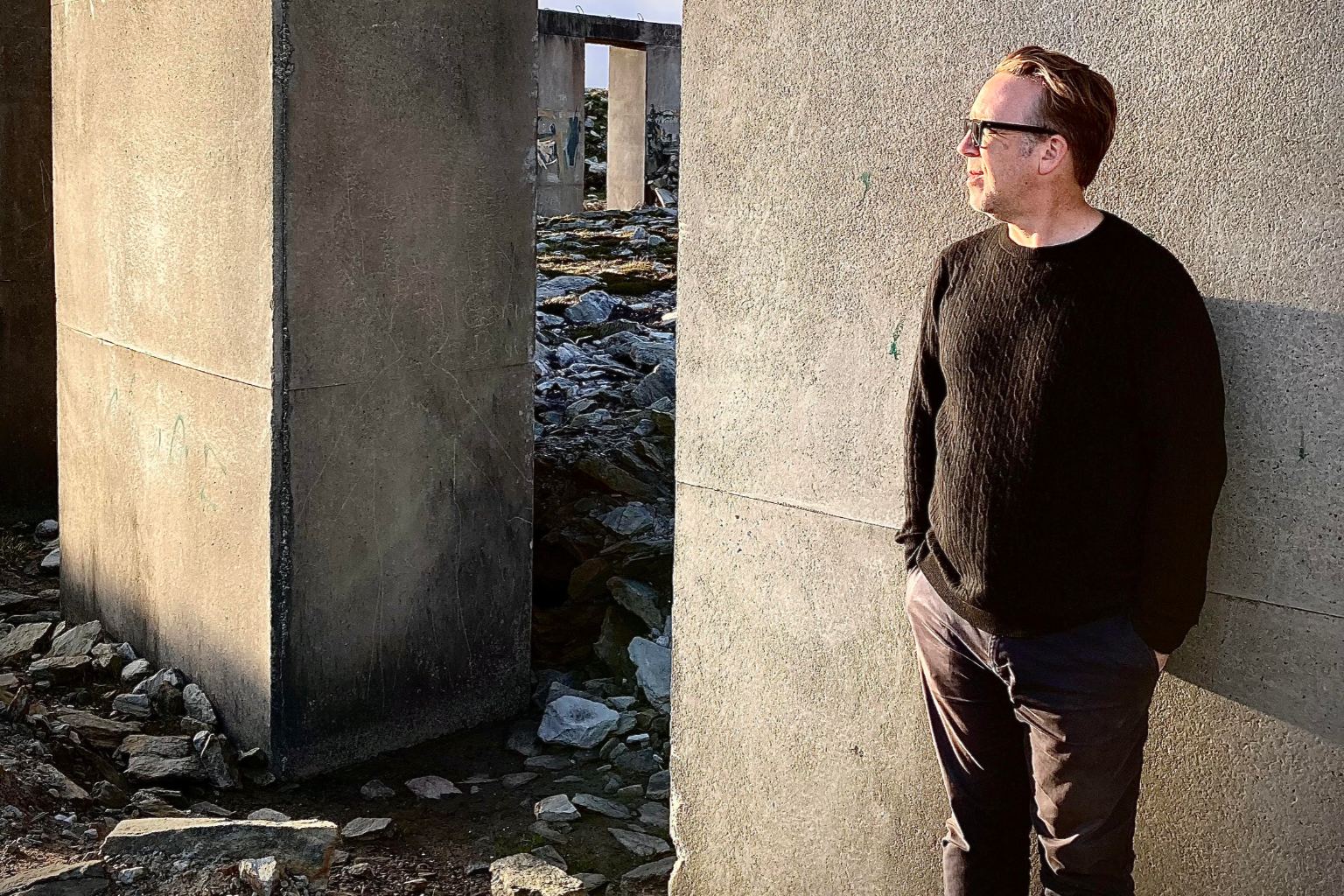
Sebastian Mullaert:
Your approach to electronic music has always been very open-ended, particularly in the way you combine electronic production with improvisation and other musical influences. What keeps you interested in working this way?
For me, making music is to explore creativity, and to explore creativity is to explore life. Life passing through our human existence, both in the aspect of the physical body, biology, but also thoughts, emotions and the nervous system.
Music has become a tool or a language for me to explore and understand how this works, and to feel and sense what it means to let that happen – to improvise.
Creativity, allowing creativity, follows universal principles, but at the core of those principles is that everything is in flux and always changing.
So to find tools, instruments or even temporary structures that can give a voice to something that is always changing is, in one way, how I feel the meaning of life.
This journey in music and creativity, to me, can never fade in value, beauty or importance.
What makes an electronic performance feel genuinely live to you?
I actually try not to phrase the question in that way. I try to invite myself, and also inspire others, to not conceptualize what playing live is, what a performance is, or what an invitation to others is.
But through exploring what it means to you, what sharing and playing mean to you, try to be genuinely honest with what gives you the spark to be on stage. What is it you want to invite yourself, your fellow musicians and an audience to? And what do you need? How can you do that and follow what means something genuine to you?
So my wish and my focus is: how can I stay open? How can I be open to feel, to continue exploring on stage? How can I share something that means something to me and be alive when that happens?
So I would say, if I feel that I’m alive, or if I feel that someone is playing and they are there, they’re present, they’re alive, they’re sharing something that is felt through them, in them, right then, that is what I appreciate about a performance or a sharing from one human being to another.
How important is the element of uncertainty when you perform?
I try to start with security. I play in a way where I have found ways to feel secure, to feel at home. And I feel that is a great stepping stone to trusting yourself to go into uncertainty.
Uncertainty, from one perspective, is always present. We never really know. We never know exactly what will happen. We don’t know what we will feel. We don’t know what triggers will be triggered within us. We don’t know what thoughts or impulses will come up.
And neither do we know what happens in the people we play with, what they will play, or how they will react to something you voice. And then we have the audience. We have the room.
To feel secure and to be able to stay open means that you can hold moments of uncertainty. Also those moments when uncertainty might trigger insecurity, fear or maybe dislike within yourself.
And those things are beautiful. Those things can also help you put light on spaces within yourself that you are avoiding. And to find moments to put light on those, also in a concert or in an improvisation, is to explore creativity and your musical expression.
And to be able to do this, I think the most important tool is to hold space, to rest in your presence, in the awareness that is aware of everything that happens, the whole experience that you are having in that moment.
So as a side note, I think that’s the most important reminder to all of us: return to this awareness. Be aware of this awareness continuously. That is the space where you can also hold what is uncertain and even uncomfortable.
Your live setups have evolved considerably over the years. How do you decide what belongs in your setup and what you can afford to leave behind?
That’s true. My live sets have taken many turns, explored different directions and incorporated different technological changes and evolutions.
And normally I keep what is nurturing this perspective of improvising and exploring in the moment.
Often I have many different ideas that I put into my live sets, and normally just a few of them actually make sense.
Thoughts and ideas are amazing, but they are not always for you, and they are not always true. You have to embody them. You have to play with them to test and understand if the idea was actually for you or not.
How much do you prepare before a performance, and how much do you want to discover once you are actually in the room?
My live setup consists of lots and lots of sketches, or you could call them small musical islands, collections of sounds that together create a space, an environment, a feeling, a mood, but do not have a specific arrangement.
And my setup is made in such a way that I can create and play those arrangements on the fly with a collection of sounds. You can see it as a bunch of separate loops that just continue into eternity, but by moving faders and knobs, I can create a journey or a narrative with them.
And those spaces, islands or sketches are starting points. On top of that, I have a lot of different instruments, drum machines, effects and loopers, where I can write melodies, play things live on top and loop things to take the soundscape in completely new directions.
So what I do in a specific concert is, first of all, I can choose between all these hundreds of sketches that range from very slow to very fast tempos, very different emotions and even musical genres.
And then I can arrange them and play things live on top in a way that meets what I feel in that moment. And what I feel is, of course, a combination of me, the other artists, the room and the audience.
How does the audience influence the way you perform?
The more I can stay present and open, the more I trust myself, the more I can allow myself to be inspired and influenced by everything around me, including, in this case, an audience.
I think the more I narrow or shrink into fear and doubt, the more I try to defend something rather than open up to something.
And here is also, I think, a very universal human aspect: when we feel that we are seen and heard, when we feel trust from our environment, we relax, and we can play out. We can, with the support from our surroundings, explore the genius and beauty of ourselves.
So in this way, we can actually always support and hold space for each other. It doesn’t matter what situation that is, if it’s the teacher who is held by the students, or if it’s an artist on stage, held and given trust by an audience.
So in this way, the audience is influencing me in two ways: of course, in the way they explore and how their bodies react to the music, but also in what way they trust me.
Can you tell when a room is asking you to take the music somewhere unexpected?
I think here it’s also good to mention that essentially all expressions are patterns. Everything we see around us is patterns. Life is patterns evolving, changing, being born, living, dying.
And an audience, as a collective group, also holds patterns of different kinds. And here, as an artist, I think you have to explore and decide what your intentions are with the invitation you give to an audience.
And of course the audience is influencing you, as I answered in the previous question. But the reaction of a crowd doesn’t necessarily need to tell you what to do, or guide you to exactly what to play.
There are also a lot of patterns in our societies, in how we live, that create stress and restlessness. And I think music and art are important tools to challenge this, and to give people a chance to slowly dissolve those patterns that are not necessarily good for them.
So sometimes I really consciously challenge a certain pattern of stress or restlessness to try to give the audience a chance to transcend or penetrate that and rest into something deeper, where another, deeper experience can take place.
But to return to the question of taking the music somewhere unexpected, I think that is exactly what happens when this collective work between an artist and an audience, with mutual trust and holding space, reaches a point where there is so much allowance and a clear opening to take things in a direction that is not expected.
And when that happens, I think that’s one of the treasures, one of the real beauties of a concert where artist, audience and space align.
You have worked across clubs, festivals, collaborative projects and more experimental settings. How does the environment change your approach to playing live?
My setup and my way of playing live follow the same principles, but how it sounds, the vibe, the energy and the musicality are always changing depending on the setting, and also, of course, if there is a certain function for the concert.
If it’s a club and people are dancing, the music and my performance serve a certain function. If it’s a sleeping concert, there is another function. If it’s a sound installation in an art museum, it’s another. If it’s a seated concert in a concert hall, there is another framework that changes the music, or the way the music is played.
But I always play with my spaces and soundscapes, my sketches, and improvise from them. When I play with others, the invitations are extended to other artists.
Your new album Holds The Sky, created with Tamarma, came from a year-long creative exchange through your In Bloom mentorship programme. How did that relationship shape the music?
When Tamarma joined my mentorship programme, she actually did three different steps, so it was over two years.
I heard Tamarma’s music, Tamarma’s voice, and felt that very genuine and beautiful expression. I think somehow I also connected with the beauty of another artist expressing her voice in a very open and naked way. And that was the whole catalyst for the project, which then led to the album.
I think the fact that I was a mentor and Tamarma, in that framework, a student, did not affect our musical relationship in any way.
I don’t think I’m very hierarchical or judgmental, or that I need to prove myself. So for me, it’s quite easy to meet anyone in a very equal and human way.
The album brings together your open-ended electronic approach with Tamarma’s voice and Georgian musical heritage. What did you discover through working with those different musical perspectives?
I think every time I work on or express any music, it’s not really about discovering something new. It’s always just remembering the immense beauty of letting music take form without really planning it, but letting it be shaped and just being there when it happens, allowing that spark, that curiosity.
That really happened when we made this album, and it’s also why I really love this album so much.
What did you learn from the process of making Holds The Sky that you think will stay with you in your own music?
The process of making Holds the Sky is really how I always make music. So it will not really change anything in how I make my own music.
At the same time, of course, every little piece of expression always leads to something else. But I can’t really say anything specific that will change.
You have spent decades exploring different approaches to electronic music. What still makes you curious enough to keep changing the way you create and perform?
As we started the interview, to allow creativity, to explore creativity, to manifest life through your humanity is really what life is about.
And I think that curiosity, but also resting in the knowing that this is what really matters, will naturally always give meaning to the importance of music, art and expressions in general.
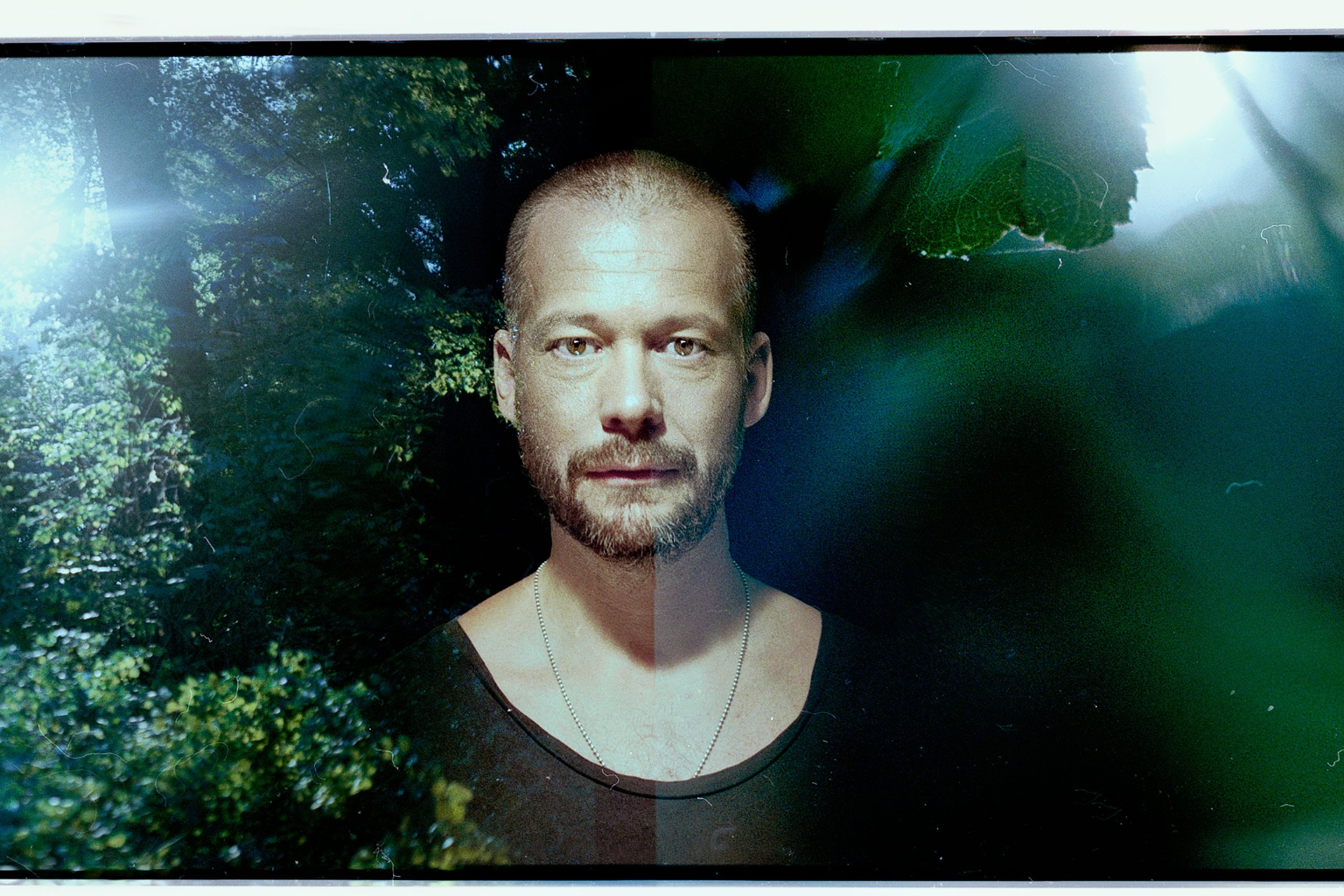
For all three artists, live performance is about presence, trust and the willingness to let something unrepeatable happen. Each works differently, from Stimming’s hardware-driven reworking of finished tracks to Sebastian’s collection of musical sketches and Christopher’s improvised, modular-led approach, yet each places the connection between artist, audience and space at the centre of what they do. At Akasha Ibiza, that shared outlook will be put into practice across a full night of entirely improvised music.
Awesome Soundwave Live x Ethereal takes place on Friday 16 October at Akasha Ibiza, and tickets are available here.