
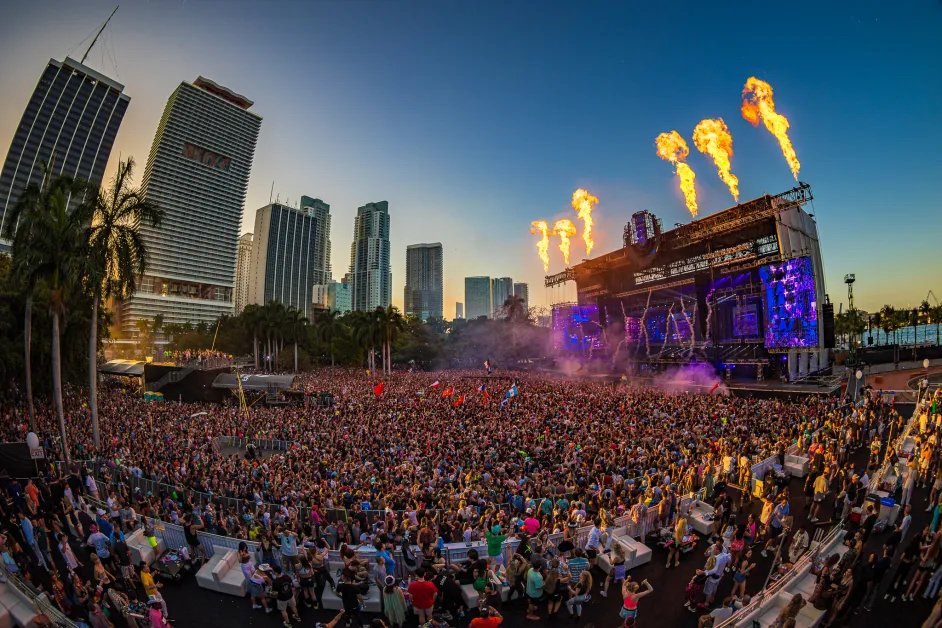
The ink on Miami’s bayfront park 20 year festival contract was barely dry when things got complicated. One day before the city commission unanimously approved a long-term operating agreement keeping Ultra Music Festival at Bayfront Park through 2046, the Downtown Neighbors Alliance filed a lawsuit against the festival’s parent company, alleging years of noise violations and a broken promise buried in a 2021 settlement.
That settlement was supposed to be the peace treaty. It mandated a Sound Management Program with agreed-upon decibel caps, and a DNA leader said at the time it would allow the festival and its downtown neighbors to coexist. The new lawsuit argues that agreement was never honoured. The complaint describes Ultra’s sonic output as an “apocalyptic, ear-shattering, and relentless sonic assault” on Downtown Miami residents, and accuses the festival of breaching the terms both sides had signed off on five years ago.
The city commission did not wait for any resolution. Adam Cervera, General Counsel for the Downtown Neighbors Alliance, asked commissioners to defer the vote and let both sides reach an agreement first. They declined. What the DNA did secure, in a concession they characterised as at least a partial win, was a structural amendment to the contract itself. The original proposal was built around two 10-year terms as part of this ultra miami long-term agreement. Commissioners revised it into four five-year periods, each requiring Ultra to present a formal report to the commission for review. The new contract also incorporates the 2021 settlement’s decibel limits and commits Ultra to holding two community meetings every year.
For anyone trying to understand the festival community impact of all this, the history matters. The Downtown Neighbors Alliance previously pushed Ultra off Bayfront Park entirely in 2019, forcing the festival to relocate to Virginia Key. Ultra returned to its original home in 2022 after the pandemic hiatus, with that 2021 settlement in place as a framework for coexistence. The lawsuit suggests, from the residents’ perspective, that framework collapsed in practice even if it held on paper.
Ray Martinez, Ultra’s Chief Administrative Officer, responded firmly in a statement. “Ultra will vigorously defend against it and continue operating within any applicable City-established frameworks,” he said, adding that the city-approved agreement creates a district-wide governance structure addressing broader community impacts. Ultra co-founder and CEO Russell Faibisch took a warmer tone on social media, calling the 20-year deal “a historic moment for the City of Miami and for the global electronic music community” and framing the commission’s vote as “a clear mandate from the residents of the City of Miami.” Whether residents living in the apartment blocks nearest the park share that reading is now, in part, a question for a judge.
The festival is secured at Bayfront Park on paper until 2046. The courts will determine what obligations come attached to that security, and whether the noise limits written into both the 2021 settlement and the new contract will finally be enforced with real consequence.